
India vs UK vs Canada vs China for African Students in 2026: The Honest, Data-Backed Comparison
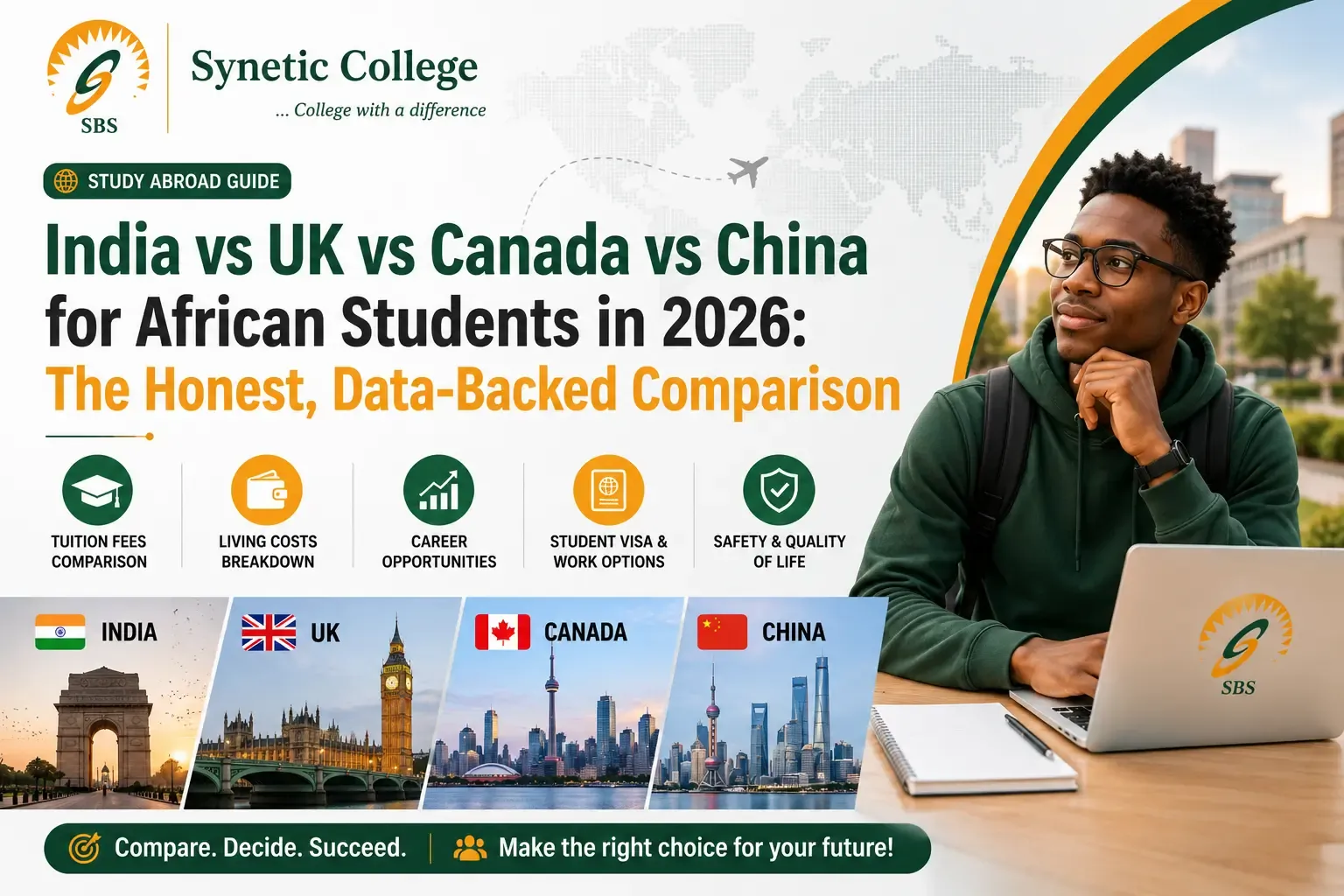
UK visa rules just tightened. Canada cut new student permits by nearly 50%. China's language barrier remains real. And India just launched an e-Student Visa. This is the comparison every African student planning to study abroad in 2026 needs to read — before they make the most important decision of their life.
The Decision That Changes Everything
If you are an African student planning to study abroad in 2026 — from Liberia, Nigeria, Ghana, Zimbabwe, or anywhere else on the continent — you are about to make one of the most significant financial and life decisions of your life.
Which country should I go to?
It is a question thousands of African families are asking right now. And the honest answer in 2026 is more nuanced — and more important — than it has ever been before. Because the global study abroad landscape has shifted dramatically in the last 18 months.
The UK just introduced sweeping new visa restrictions. Canada has cut new student permits by nearly 50% since 2024. The US is increasingly hostile to international students. China remains the second most popular destination for African students — but comes with real and well-documented challenges around language, culture, and career outcomes.
And India? India launched a brand new e-Student Visa in January 2026, is actively courting African students, and remains one of the most affordable, English-medium, degree-recognized destinations on the planet.
This guide gives you the full, honest comparison — country by country, factor by factor — so you can make this decision with real information, not brochure promises.
The 6 Factors That Actually Matter for African Students
Before comparing countries, here are the six things African students consistently say matter most when choosing where to study:
- Cost — total cost including tuition, accommodation, and living expenses
- Language — is the degree taught in English?
- Visa accessibility — how hard is it to get in and stay?
- Degree recognition — will my qualification be valid back home and globally?
- Safety and community — will I feel safe? Is there an African community?
- Career outcomes — what jobs can I get, in which countries, after graduating?
We will score each destination honestly on all six.
Country 1 — The United Kingdom
The Prestige Argument
The UK is home to some of the world's most recognized universities — Oxford, Cambridge, Imperial, UCL. A UK degree carries enormous brand value globally. For students who secure admission to a high-ranking UK institution, the prestige is real and the alumni networks are powerful.
The 2026 Reality Check
The UK has introduced a series of significant policy changes that directly affect African students planning to study there.
Post-study work visa cut. The UK has reduced the Graduate Visa from 2 years to 18 months for undergraduate and master's graduates from January 2027 onwards. PhD graduates retain 3 years. This means 6 fewer months to find a qualifying job after graduation.
Dependent visa restrictions. From January 2025, international students can only bring their partner and children if they are enrolled in a PhD or other doctoral programme. For African students with families, this is a significant practical barrier.
Higher financial requirements. From November 2025, students in London need £1,529 per month and those outside London need £1,171 per month for up to nine months, in addition to tuition fees — all held in a bank account for at least 28 consecutive days before applying.
Stricter university compliance. New rules require universities to achieve 95% enrollment rates and 90% completion rates, with visa refusal rates below 5%, to retain sponsor licence validity — raising compliance standards that could affect individual students whose universities fail to meet them.
A new international student levy. New financial obligations include a 6% international student levy that institutions will pass on to students through higher fees.
UK Cost Reality for African Students
UK tuition fees for international students: £15,000–£35,000 per year depending on the course and university. Living costs in London: £18,000–£22,000 per year. Outside London: £12,000–£16,000 per year. Total annual cost: £27,000–£55,000 (approximately USD 34,000–70,000).
UK Summary for African Students
Pros: World-class degree recognition, English medium, strong alumni networks, European proximity.
Cons: Among the most expensive destinations globally. Visa policies actively tightening. Post-study work window reduced. Dependent visa restrictions affect students with families. The government has explicitly stated its intention to reduce international student numbers — particularly at lower-ranked institutions.
Best for: Students with strong academic profiles targeting top-20 UK universities, with full financial backing, no dependents, and a clear plan to transition to a Skilled Worker visa within 18 months of graduation.
Honest verdict: If you cannot get into a top-30 UK university, the cost-benefit calculation for a UK degree in 2026 is difficult to justify — especially compared to India.
Country 2 — Canada
The Reputation
Canada built a decade-long reputation as the most welcoming, immigrant-friendly study destination in the world. Generous post-graduation work permits, pathways to permanent residency, affordable tuition relative to the UK, and multicultural cities made it enormously popular. African student numbers grew rapidly through 2023.
The 2026 Reality Check
Canada has made a dramatic policy reversal — and the numbers tell the story clearly.
Permit caps slashed. The 2026 target is 7% lower than 2025 and 16% lower than 2024, with new international student admissions projected to fall by nearly 50%, from 305,900 to 155,000.
Study permit holders falling sharply. Canada had more than 1 million study permit holders in January 2024. By September 2025, that number had fallen to about 725,000. The government plans to keep pushing this number down to meet its goal of reducing the temporary resident population to below 5% of the national total by the end of 2027.
Approval rates collapsed. The study permit approval rate through the first half of 2025 was just over 30%, compared to 51% for the same period in 2024. That means 7 out of 10 applicants are being rejected.
Higher financial proof required. From September 2025, applicants must show access to at least CA$22,895 (for one person) in addition to first-year tuition as proof of living funds.
Canada Cost Reality for African Students
Tuition: CAD $15,000–$30,000 per year. Living costs: CAD $12,000–$18,000 per year. Total annual cost: CAD $27,000–$48,000 (approximately USD 20,000–36,000). Getting cheaper relative to UK — but increasingly inaccessible due to caps and approval rates.
Canada Summary for African Students
Pros: Strong degree recognition, English medium, previously clear pathways to permanent residency.
Cons: New international student admissions are expected to fall by nearly 50%, with approval rates at historic lows. The government has explicitly prioritised reducing its international student population. African students are facing elevated rejection rates. The permanent residency pathway — once Canada's main draw — is now slower and less certain.
Best for: Master's and PhD students at public universities (who are exempt from the permit cap as of 2026) with very strong academic profiles and financial backing.
Honest verdict: Canada was the dream destination of the 2018–2022 era. In 2026, the door is actively closing for undergraduate students from Africa. The rejection rate alone — 70% of applicants turned away — makes it a high-risk, high-cost gamble for most African families.
Country 3 — China
The Numbers
China is the second most popular destination for African students studying abroad after France. In 2018, China hosted over 60,000 African students, making it the second most popular destination for African students abroad after France — ahead of the US and UK. Chinese government scholarships, affordable tuition, and medicine programs have been the primary draws.
What African Students Actually Experience in China
The academic research on this topic is extensive and consistent. International students in China encounter challenges including language barriers, culture shock, and perceived discrimination.
The language wall. Although basic Mandarin courses are offered to African students in the first year, their Chinese level remains relatively weak. Documents and the education system are all in Chinese, requiring significant time and support to assist African students through administrative processes.
Social integration challenges. There have been a number of conflict-ridden contexts and intercultural challenges — racial and ethnic discrimination reported by participants — emerging as a potential barrier to positive social interaction.
Academic mismatch. A major challenge faced by students was access to English learning resources. Medical trainees had the added challenge of having to interact with patients during clinical sessions in Chinese.
China Cost Reality
Tuition: USD $2,950–$8,000 per year (medicine up to USD $5,000). Living costs: USD $300–$600 per month. Total annual cost: USD $6,500–$15,000. This is China's genuine competitive advantage — it is among the cheapest degree destinations globally.
China Summary for African Students
Pros: Very affordable fees, government scholarships available, medicine programs popular, growing university rankings.
Cons: Serious language barrier for most programs and daily life. Cultural shock and perceived discrimination are well-documented challenges affecting academic performance and wellbeing. Career value of a Chinese degree outside China is limited — Mandarin proficiency is required for most China-based career paths, which most graduates do not achieve.
Best for: Students specifically targeting Chinese government scholarships for medicine or STEM, with a long-term plan to work in China or in Chinese-African business contexts.
Honest verdict: China is affordable, but the language barrier and documented social integration challenges make it a difficult environment for most African undergraduate students. Unless you have a scholarship and a specific reason to build China-based career ties, the language investment required is significant.
Country 4 — India
The Emerging Powerhouse for African Students
India is not the most glamorous study destination. It does not have the brand recognition of the UK or the cultural familiarity of China. But in 2026, it has something more valuable than either: a combination of factors that no other country currently offers African students simultaneously.
The January 2026 Game-Changer: The e-Student Visa
In January 2026, the Government of India launched a fully online e-Student Visa — eliminating the need for an in-person embassy visit for students admitted through the Study in India portal. This is a direct response to African students' feedback that embassy access was a barrier, and it dramatically simplifies the pathway to an Indian education.
English. Completely.
Every degree program at SBS Synetic Business School — and at government-affiliated universities across Punjab — is taught entirely in English. There is no Mandarin to learn. No language wall to climb. You arrive, you study, you graduate — all in English. Your degree is written in English and recognised internationally.
This is not a small point. It is the single biggest practical advantage India has over China for African students.
The Degree Recognition Question
Indian degrees from UGC-approved, NAAC-accredited government universities are recognised globally. The Association of Indian Universities (AIU) issues an Equivalence Certificate for international students — making the qualification valid for employment and further study in Africa, the Middle East, Europe, and beyond.
At SBS, every degree program is affiliated with a government university that is UGC-approved and NAAC-accredited. Students receive AIU Equivalence Certification as part of their graduation process. The degree works at home and internationally.
The 50% Automatic Scholarship
Every African and international student at SBS receives an automatic 50% tuition fee waiver — funded by the Zayn Educational Trust. No application. No competition. No conditions. You qualify by being an international student.
This is not available in the UK. It is not available in Canada. China has limited government scholarships that require separate competitive applications. At SBS, the scholarship is guaranteed.
India Cost Reality for African Students
After the SBS 50% scholarship:
- Degree programs (3–4 years): Total program cost of approximately USD $2,170–$3,930 for the full degree
- Accommodation: USD $50–$100 per month (partner guest house, 7 minutes from campus)
- Food and living: Approximately USD $60–$100 per month in Ludhiana
Total estimated annual cost at SBS (tuition + accommodation + living): Approximately USD $2,000–$3,500 per year — all-inclusive. Tuition alone is just $300 per semester after the 50% scholarship.
No other country in this comparison comes close to this number for a fully English-medium, government-affiliated, internationally recognised degree.
Safety and Community in India
India's cultural diversity means African students encounter a range of experiences. Ludhiana specifically has a thriving African student community — SBS hosts students from over 16 countries including Liberia, Nigeria, Ghana, Zimbabwe, Gambia, and Somalia.
The SBS International Students Meet — where hundreds of African students from colleges across India gathered at the Ludhiana campus — is evidence of the community that exists here. Students do not navigate India alone. They navigate it together, supported by an institution that has been welcoming African students for over 20 years.
Career Outcomes
An Indian degree in Business Administration, Computer Applications, Medical Lab Science, or Textile Design provides employment value in three markets simultaneously:
- Africa — an internationally recognised degree with AIU equivalence, valued by employers
- India — SBS's placement cell and UMEED Mega Job Fair connect graduates with 35+ companies actively hiring
- Middle East and beyond — Indian degrees are well-recognised in the Gulf, with many SBS alumni employed across UAE, Qatar, and Saudi Arabia
India Summary for African Students
Pros: Fully English-medium degrees. Guaranteed 50% scholarship at SBS. Tuition of $300 per semester after the scholarship, and a total annual cost of USD $2,000–$3,500. E-Student Visa (fully online process from January 2026). UGC-approved, NAAC-accredited, AIU-equivalent degrees. Established African student community. 20+ years of international student experience at SBS.
Cons: Less international brand recognition than UK universities. Requires FRRO registration within 14 days of arrival. Cultural adjustment is real — but manageable with community support.
Best for: African students who want a high-quality, internationally recognised, English-medium degree at a fraction of the cost of Western destinations — with a guaranteed scholarship, a supportive community, and placement support built in.
Honest verdict: In 2026, India is the best value study destination in the world for African undergraduate students. The combination of English medium, affordable cost, guaranteed scholarship, accessible visa, and internationally recognised degree is unmatched by any other country on this list at the undergraduate level.
The Side-by-Side Comparison
Annual Total Cost (Tuition + Living):
- India (SBS): USD $2,000–$3,500 per year ($300 per semester in tuition) ✅ Lowest
- China: USD $6,500–$15,000
- Canada: USD $20,000–$36,000
- UK: USD $34,000–$70,000
Taught in English:
- India: Yes, fully ✅
- China: Partially (many programs require Mandarin)
- Canada: Yes ✅
- UK: Yes ✅
Scholarship for African Students:
- India (SBS): Automatic 50%, guaranteed ✅
- China: Competitive government scholarships available
- Canada: Limited merit scholarships
- UK: Limited, highly competitive
Visa Accessibility in 2026:
- India: New e-Student Visa, fully online ✅
- China: Accessible
- Canada: Only 155,000 new permits, 30% approval rate ⚠️
- UK: Tightening significantly ⚠️
Post-Study Work Option:
- India: Build career in India, Africa, or Middle East
- China: Requires Mandarin for most roles
- Canada: Post-graduation work permit (if you get in)
- UK: 18 months post-study (reduced from 24)
African Student Community:
- India: Large and growing (SBS: 16+ countries) ✅
- China: Large but challenging integration
- Canada: Multicultural, welcoming
- UK: Present but expensive to maintain
Degree Recognition:
- India: UGC/NAAC/AIU recognised ✅
- China: Recognised, Mandarin dependent for career
- Canada: Globally strong ✅
- UK: Globally strongest ✅
The Honest Conclusion
In 2026, the global study abroad environment has shifted significantly against African undergraduate students at the traditional Western destinations.
Canada's new international student admissions are projected to fall by nearly 50%, with a 30% approval rate making it increasingly inaccessible. The UK has introduced a 6% international student levy, reduced post-study work from 24 to 18 months, and tightened university compliance standards — all adding cost and uncertainty. China's documented language and social integration challenges make it a difficult environment for most African undergraduates seeking English-medium, career-focused education.
India — and specifically Ludhiana, the industrial capital of Punjab — offers something no other destination currently matches: a fully English-medium, government-university-affiliated, internationally recognised degree, with an automatic 50% scholarship, a new fully online visa process, and a total annual cost that is 10 to 20 times lower than Western alternatives.
This is not an anti-UK, anti-Canada, or anti-China argument. It is a 2026 reality check. The doors to the West are getting narrower and more expensive. The door to India is getting wider, more accessible, and more structured.
At Synetic Business School in Ludhiana, we have been welcoming African students from 16+ countries for over 20 years. Our admissions team responds to WhatsApp messages within hours. Our scholarship is automatic. Our doors are open.
WhatsApp us today to start your 2026 admission process.
Frequently Asked Questions
Which country is best for African students to study abroad in 2026?
Based on cost, accessibility, English-medium instruction, degree recognition, and scholarship availability, India is the strongest value destination for African undergraduate students in 2026. UK and Canada are increasingly expensive and restrictive. China has language and integration challenges. India offers government-university-affiliated English-medium degrees with automatic scholarships and a new online e-Student Visa.
Is it hard for African students to get a Canada student visa in 2026?
Yes. New international student admissions to Canada are projected to fall by nearly 50% in 2026, from 305,900 to 155,000. Study permit approval rates fell to approximately 30% in 2025. African students face significantly higher rejection risk than in previous years.
What are the new UK student visa rules for African students in 2026?
The UK has reduced the post-study Graduate Visa from 2 years to 18 months for undergraduate and master's graduates from January 2027. Students can no longer bring dependents unless enrolled in a PhD or research programme. Higher financial proof requirements and a new international student levy add further cost. The UK is actively working to reduce international student numbers.
What are the challenges for African students in China?
Research consistently shows that African students in China encounter language barriers, culture shock, and discrimination. Documents and the education system are in Chinese, requiring significant support for African students to navigate. Career outcomes in China also largely require Mandarin proficiency, which most students do not reach during a 3-4 year undergraduate degree.
How much does it cost for an African student to study in India in 2026?
At Synetic Business School in Ludhiana, African students receive an automatic 50% tuition scholarship. After the scholarship, tuition is $300 per semester, and the total annual cost — including tuition, accommodation, and living expenses — is approximately USD $2,000–$3,500 per year. This is significantly lower than UK, Canada, or most Chinese universities.
Is an Indian degree recognised in Africa?
Yes. Indian degrees from UGC-approved, NAAC-accredited government universities are internationally recognised. The Association of Indian Universities (AIU) issues an Equivalence Certificate to international students, formally recognising their Indian qualification for use in Africa, the Middle East, and globally.
Can African students study in English in India?
Yes. All programs at SBS Synetic Business School — and at government-affiliated universities across Punjab — are taught entirely in English. No Mandarin, no Hindi requirement. The entire degree, examinations, and graduation process are conducted in English.
What is the e-Student Visa India 2026 for African students?
India launched a new e-Student Visa in January 2026 — a fully online process that eliminates the need to visit an Indian embassy or consulate in person. Students admitted through the Study in India government portal can apply entirely online. This makes India's student visa process significantly more accessible for African students.
Is India safe for African students from Liberia, Nigeria, Ghana, and Zimbabwe?
India has a large and established African student community. Ludhiana specifically has students from 16+ African countries studying at SBS. The college has 20+ years of experience welcoming international students and provides comprehensive arrival support, FRRO registration guidance, and a community of fellow African students to ease the transition.
How do I apply to SBS Ludhiana from Africa?
WhatsApp the SBS International Admissions Team directly. Our team responds within hours and guides you through the application, admission letter, visa process, and pre-arrival checklist. The entire process can be completed remotely — you do not need to visit India before your visa is approved.
Explore at SBS
Continue Reading
The Complete Guide for African Students Studying in India: Fees, Scholarships & Cost of Living
Sep 21, 2026 · 10 min read
India Student Visa 2026: The Complete Step-by-Step Guide for African Students (Liberia, Nigeria, Ghana, Zimbabwe)
May 12, 2026 · 9 min read
Canada Is Rejecting Up to 80% of Indian Student Visas in 2025 — Why Punjab & Ludhiana Students Are Rethinking the Plan
Sep 28, 2026 · 11 min read
Written by
SBS Admissions Office
Synetic Business School — sharing stories, insights, and updates from our campus in Ludhiana, Punjab.