
BBA vs BCA vs B.Com After 12th: Which is Best for You in 2026? (Punjab Students Guide)
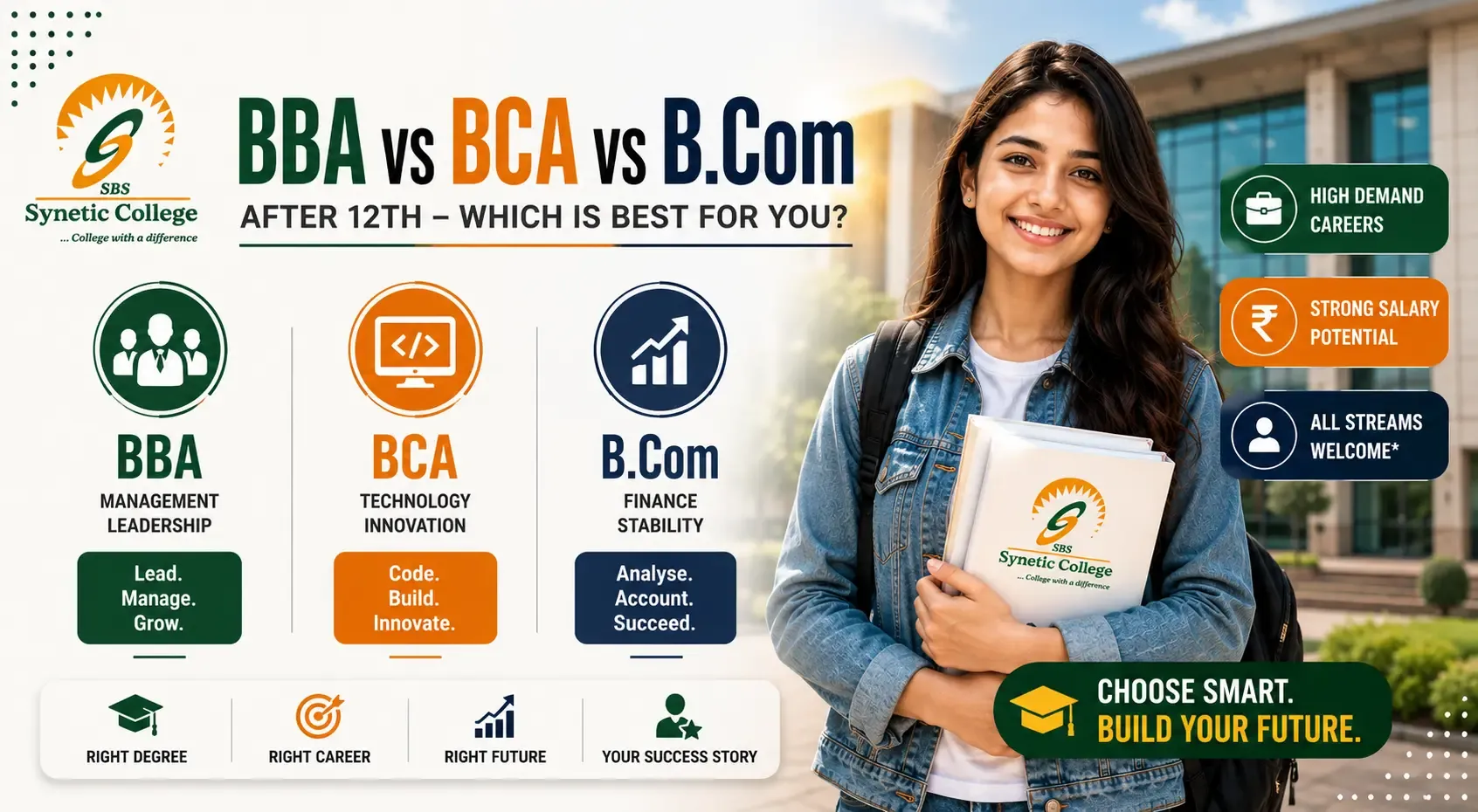
Commerce student? Arts student? Not sure which degree to pick? This honest, data-backed comparison of BBA, BCA, and B.Com covers salaries, careers, scope, and which course suits which type of student in Punjab in 2026.
The Question Every 12th Student in Punjab is Asking Right Now
You have just cleared your Class 12 boards. Now everyone — your parents, your relatives at family dinners, your school friends — has an opinion. "Do BBA." "BCA is the future." "B.Com always has jobs." And somehow, the more people you ask, the more confused you feel.
This guide cuts through all of it.
We are going to compare BBA, BCA, and B.Com honestly — not with vague phrases like "great scope" and "bright future" — but with actual salary data, real career paths, and a clear framework to help you figure out which degree fits you specifically, not your cousin, not your neighbour's son.
Let us start from the very beginning.
What Are These Three Degrees, Really?
Before comparing them, it is worth understanding what each degree actually trains you to do:
BBA — Bachelor of Business Administration
A 3-year degree focused on how businesses operate. You study marketing, finance, HR, operations, strategy, and entrepreneurship. It is designed to build managers — people who understand how organizations work from the inside. The natural next step after BBA is an MBA. It is open to students from Commerce, Science, and Arts streams.
BCA — Bachelor of Computer Applications
A 3-year degree focused on technology — programming, software development, databases, networking, and increasingly, artificial intelligence and cybersecurity. It is the non-engineering route into India's IT sector. Think of it as a B.Tech-lite that costs a fraction of the price. Open to students from all streams, including Commerce and Arts.
A 3-year degree with deep roots in accounting, finance, taxation, business law, and auditing. It is the traditional commerce route — the foundation for students planning to become Chartered Accountants (CA), or work in banking, finance, and accounting. Open primarily to Commerce stream students, though some colleges accept all streams.
The Honest Salary Comparison (2026 Data)
Here is what each degree actually pays — based on current 2025–26 hiring data from across India:
BBA Starting Salary (2026)
- Fresher salary range: ₹3–5 LPA (₹25,000–₹42,000/month)
- With digital marketing specialisation: ₹3.5–6 LPA
- Mid-career (3–5 years): ₹8–12 LPA
- Senior roles (Marketing Head, Business Development Manager): ₹15–25 LPA+
- BBA freshers with skills in digital marketing or data analytics command 30–50% higher starting packages than general BBA graduates
BCA Starting Salary (2026)
- Fresher salary range: ₹2.5–4.5 LPA (₹21,000–₹38,000/month)
- With AI/game development specialisation or strong project portfolio: ₹4–8 LPA
- Mid-career (3–5 years): ₹6–15 LPA
- Senior roles (Full Stack Developer, Data Analyst, Cybersecurity Expert): ₹12–25 LPA+
- BCA is the highest-ceiling degree of the three for students willing to build technical skills consistently
B.Com Starting Salary (2026)
- Fresher salary range: ₹2.5–4.5 LPA (₹21,000–₹37,000/month)
- B.Com + CA (Chartered Accountant): ₹7–15 LPA starting
- Mid-career finance roles: ₹6–10 LPA
- Banking and government sector roles offer strong stability and structured growth
The honest summary on salary: BCA has the highest ceiling for technical roles. BBA with a digital marketing or analytics specialisation outperforms generic BBA significantly. B.Com's true ROI unlocks if you combine it with CA or another professional qualification.
Career Paths: Where Does Each Degree Actually Take You?
After BBA — Where Do You Work?
BBA graduates are employed across virtually every industry in India. The most common career paths are:
- Digital Marketing Executive / Manager — managing brand presence, paid ads, SEO, and content strategy for companies
- Business Development Executive — identifying new clients and markets for corporate sales teams
- Marketing Manager — leading product and campaign strategy
- HR Executive / Recruiter — talent acquisition and workforce management
- Operations Manager — managing logistics, supply chains, and business processes
- Entrepreneur — BBA is one of the best foundations for starting your own business
- MBA route — BBA is the strongest preparation for MBA entrance exams (CAT, MAT, XAT) and IIM admissions
Who hires BBA graduates? Banking and financial services companies (ICICI, HDFC, Axis Bank), retail and FMCG brands (Reliance, HUL, ITC), IT services companies (TCS, Infosys, Wipro's business teams), startups and D2C brands, marketing agencies, and consulting firms.
After BCA — Where Do You Work?
BCA graduates enter India's ₹10 lakh crore IT sector — which added over 1.26 lakh net new jobs in FY2024–25 alone. Key career paths:
- Software Developer / Full Stack Developer — building applications and websites
- Data Analyst — turning raw data into business decisions using SQL, Python, and Excel
- Game Developer — designing and building games (especially with BCA + Game Development specialisation)
- Cybersecurity Analyst — protecting networks and systems from threats
- Cloud Engineer — managing cloud infrastructure on AWS, Azure, or Google Cloud
- UI/UX Designer — designing digital products and user experiences
- MCA route — Master of Computer Applications after BCA opens doors to senior technical roles at companies like American Express, JP Morgan, and Accenture at ₹13–18 LPA starting packages
Who hires BCA graduates? TCS, Infosys, Wipro, HCL, Tech Mahindra, Tekki Web Solutions, game development studios, fintech startups, government IT departments (NIC, DRDO, ISRO), and every company that needs a digital presence.
After B.Com — Where Do You Work?
B.Com graduates are the backbone of India's finance and accounting industry:
- Accountant / Junior Accountant — bookkeeping, GST filing, financial records
- Banking Officer — roles at SBI, HDFC, ICICI, Axis, Kotak through banking examinations
- Tax Consultant / GST Specialist — working in CA firms and corporates
- Financial Analyst — investment research, budgeting, forecasting
- CA Foundation route — B.Com provides the ideal academic base for Chartered Accountancy
- Government finance roles — SSC CGL, IBPS, RBI Grade B, and other competitive exams
Who hires B.Com graduates? Accounting and CA firms, banks, insurance companies (LIC, Star Health, HDFC Life), corporate finance teams across all industries, and government departments.
The 2026 Game-Changer: Specialisations That Supercharge Your Degree
Here is the shift that most students and parents are not fully aware of yet: the generic version of any degree has become less valuable, while specialised versions have become significantly more valuable.
A standard BBA graduate competes against thousands of identically qualified candidates. But a BBA with Digital Marketing graduate enters the job market with a specific, measurable skill set that every business in India actively needs right now.
The same logic applies to BCA:
A standard BCA graduate learns programming basics. But a BCA with AI and Game Development graduate enters a market where India will need nearly 1 million AI professionals by 2026, and the gaming industry is growing at 28% annually.
This is exactly why Synetic Business School's new MBCIE-collaborated programs are structured around specialisations that are directly employment-linked from day one:
- BBA with Digital Marketing — combining management fundamentals with hands-on SEO, social media strategy, performance marketing, and AI marketing tools
- BCA with Game Development — coding, game engine mechanics, Unity/Unreal skills, and interactive media development
- B.Sc IT with Artificial Intelligence — machine learning, GenAI applications, and prompt engineering alongside a government-university-affiliated degree
These are not theoretical add-ons. They are live projects, industry training, and advanced certifications built directly into your graduation curriculum.
The Real Question: Which Course is Right for *You*?
Stop asking "which course is better" and start asking "which course suits me better." Here is a practical decision framework:
Choose BBA if:
- You enjoy talking, presenting, negotiating, and leading people
- You are interested in marketing, sales, finance, HR, or entrepreneurship
- You want a degree that is applicable across every industry
- You plan to do an MBA after graduation
- You are comfortable with people-facing roles and business strategy
- You come from Commerce, Science, or Arts — all streams are eligible
Choose BCA if:
- You enjoy logic, problem-solving, and figuring out how systems work
- You are interested in technology, coding, gaming, or AI
- You want the highest salary ceiling of the three degrees
- You are comfortable with a learning curve — technology requires consistent upskilling
- You want to work in the IT sector without doing a full B.Tech engineering degree
- You come from Commerce, Science, or Arts — all streams eligible at SBS
Choose B.Com if:
- You genuinely enjoy numbers, accounting, and financial analysis
- You plan to pursue CA (Chartered Accountancy) as a professional qualification
- You want a strong base for banking exams and government finance sector jobs
- You prefer structured, exam-oriented academic learning
- You come from Commerce stream primarily
One More Thing: What If You Are from the Arts Stream?
This is the question barely any college addresses. If you studied Arts in Class 11 and 12, most people assume your options are limited. They are wrong.
At SBS, BBA and BCA are both open to Arts stream students. And honestly, Arts students who choose BCA often become excellent designers, UI/UX professionals, and game developers — because creative thinking is a genuine advantage in technology careers. Arts students who choose BBA often become exceptional marketers and brand strategists.
Your stream does not define your ceiling. Your drive does.
BBA vs BCA vs B.Com: Side-by-Side Comparison
Duration: All three are 3 years
Stream Required:
- BBA: All streams (Commerce / Science / Arts)
- BCA: All streams (Commerce / Science / Arts)
- B.Com: Primarily Commerce (check college eligibility)
Best For:
- BBA: Management, marketing, entrepreneurship, MBA preparation
- BCA: IT, software, AI, game development, tech careers
- B.Com: Finance, accounting, banking, CA pathway
Starting Salary Range:
- BBA: ₹3–5 LPA (up to ₹6 LPA with specialisation)
- BCA: ₹2.5–4.5 LPA (up to ₹8 LPA with strong portfolio)
- B.Com: ₹2.5–4.5 LPA (₹7–15 LPA with CA)
Salary Ceiling (5–7 years):
- BBA: ₹15–25 LPA+
- BCA: ₹20–35 LPA+ (technical roles)
- B.Com: ₹10–20 LPA+ (with CA/finance specialisation)
Top Career Roles:
- BBA: Marketing Manager, Business Developer, HR Head, Entrepreneur
- BCA: Software Developer, Data Analyst, AI Engineer, Game Developer
- B.Com: Accountant, CA, Financial Analyst, Banking Officer
Higher Education Path:
- BBA → MBA (IIMs, top B-Schools)
- BCA → MCA, M.Sc IT, MBA-Tech
- B.Com → CA, M.Com, MBA Finance
What SBS Offers Across All Three Programs
At Synetic Business School, Ludhiana, all three programs — BBA, BCA, and B.Com — are affiliated with UGC-approved, NAAC-accredited government universities. Every student receives:
- A government university-affiliated degree that is nationally and internationally recognised
- Industry visits to Ludhiana's top companies — from Coca-Cola and Rockman to CICU's industrial hubs
- Placement support through our annual UMEED Mega Job Fair (35+ companies, 500+ students)
- Soft skills training through partnerships with organisations like Naandi Foundation and Mahindra Rise
- AI-integrated specialisations through our MBCIE partnership — live projects, industry certifications, and advanced tech training built into your degree
For international students, the same automatic 50% scholarship applies across all programs.
Frequently Asked Questions
Which is better after 12th Commerce — BBA, BCA, or B.Com?
All three are strong options. BBA is best for students who want business and management careers or plan to do an MBA. B.Com is best for students interested in finance, accounting, and the CA pathway. BCA is best for students interested in technology, IT, and software careers. Your interest and career goal matters more than the degree itself.
Can Arts stream students do BBA or BCA after 12th?
Yes. At Synetic Business School, BBA and BCA are open to students from Commerce, Science, and Arts streams. Your 12th stream does not restrict your ability to pursue these programs.
What is the salary after BBA in Punjab in 2026?
BBA freshers in Punjab can expect starting salaries of ₹3–5 LPA. With specialisations like Digital Marketing or Business Analytics, and strong placement support, starting packages can reach ₹5–6 LPA. Salaries grow to ₹8–15 LPA within 3–5 years of experience.
What is the salary after BCA in Ludhiana and Punjab in 2026?
BCA freshers in Punjab typically earn ₹3–6 LPA depending on technical skills and project portfolio. The average BCA salary in Punjab is around ₹3 LPA, with the highest packages reaching ₹6 LPA at the fresher level. With specialisations in AI, game development, or cybersecurity, graduates from industry-linked programs command significantly higher starting packages.
Which course has the best job opportunities in Ludhiana in 2026?
All three have strong placement prospects in Ludhiana given the city's industrial base. BBA graduates are placed across banking, retail, and corporate sales. BCA graduates enter IT and tech companies. B.Com graduates join accounting firms, banks, and finance teams. SBS's dedicated placement cell and UMEED job fair support placement across all three programs.
Is BCA better than B.Com for the future?
It depends entirely on your interest. BCA leads to higher salary ceilings in technology roles and is growing rapidly due to India's IT expansion. B.Com provides a more structured, exam-tested path to finance and accounting careers with strong government sector options. Neither is universally "better" — the right one is the one that aligns with what you genuinely want to do.
Can I do MBA after BCA?
Yes. BCA graduates are fully eligible for MBA entrance exams including CAT, MAT, XAT, and CMAT. Many BCA graduates pursue MBA in Technology Management or Business Analytics, combining their technical background with management skills for roles in IT consulting, product management, and tech business strategy.
What is the difference between BCA and B.Sc IT?
BCA focuses on computer applications — software development, programming, and IT systems — with a slightly broader application orientation. B.Sc IT is more technical and science-oriented, with deeper coverage of networking, system administration, and infrastructure. Both lead to IT careers. SBS offers B.Sc IT with AI specialisation — a future-ready upgrade on the traditional B.Sc IT pathway.
Is BBA a good choice without MBA?
Yes. BBA standalone is sufficient for entry-level to mid-management roles in marketing, sales, HR, and operations. Many BBA graduates build strong careers without pursuing MBA. However, MBA significantly accelerates salary growth and opens senior management roles — especially at top companies and IIMs. BBA is the strongest undergraduate foundation for MBA preparation.
How do I apply for BBA, BCA, or B.Com at SBS Ludhiana?
You can visit the SBS campus directly on Chandigarh Road, Ludhiana (near Fortis Hospital), apply through our website, or WhatsApp our admissions team. Admissions are open now and seats are limited. Our counsellors will help you choose the right program based on your stream, interests, and career goals — no obligation, no pressure.
Explore at SBS
Continue Reading
Career After BCA in 2026: Jobs, Salary, and What to Realistically Expect in Punjab
May 13, 2026 · 11 min read
Which AI Tools Should a Commerce/BBA Student Actually Learn in 2026?
Sep 14, 2026 · 8 min read
CBSE & PSEB Class 12 Result 2026 Is Out — Congratulations, Next Steps & What To Do If You Got a Compartment
May 17, 2026 · 8 min read
Written by
SBS Editorial Team
Synetic Business School — sharing stories, insights, and updates from our campus in Ludhiana, Punjab.