
Which AI Tools Should a Commerce/BBA Student Actually Learn in 2026?
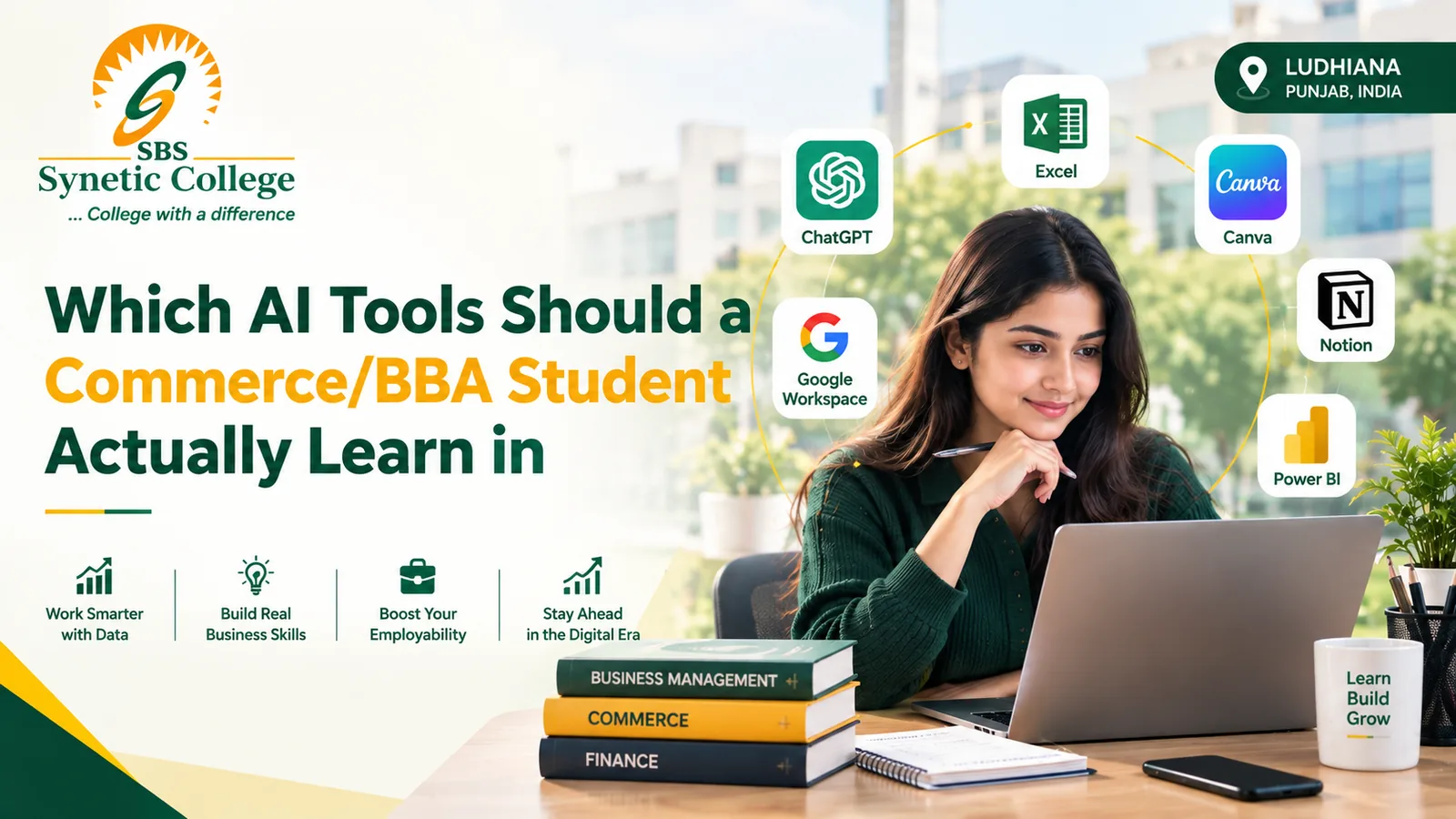
The 5 AI and productivity tools every Commerce and BBA student should actually learn in 2026 — ChatGPT, Excel, Power BI, Canva and Notion — and why each one matters for employability.
Why This Question Actually Matters Now
Every Commerce and BBA student today is entering a job market where recruiters no longer ask "do you know Excel?" — they ask what you can *do* with it, how fast, and whether you've used AI to get there quicker. The tools themselves aren't optional extras anymore; they're becoming as basic to a business degree as knowing how to read a balance sheet. The real question isn't whether to learn AI tools, it's which ones are actually worth your time. Here are the five that matter most, and why.
1. ChatGPT: The Starting Point, Not a Shortcut
ChatGPT is the tool most students already have open in another tab — but most are using it to *avoid* thinking, not to think faster. Used properly, it's a research assistant, a first-draft generator for reports and case studies, a way to stress-test an argument before a viva, and a tutor that can explain a management accounting concept five different ways until one clicks. The skill that actually matters for placements isn't "knowing ChatGPT exists" — it's prompting it well: giving it context, asking it to critique your own work instead of writing everything from scratch, and knowing when its answer is confidently wrong.
2. Excel Isn't Going Anywhere — But How You Use It Is Changing
Excel remains the single most-used tool in finance, accounting and operations roles, and that isn't changing in 2026. What's changing is the level expected of a fresher: pivot tables and VLOOKUP used to be enough to stand out; now they're the baseline. Employers increasingly expect Commerce and BBA graduates to be comfortable with Excel's own AI-assisted features — formula suggestions, data cleaning, and quick chart generation — on top of the fundamentals. This is exactly why courses like IT Tools for Business in the BBA syllabus and the Workshop on IT Tools for Business and E-Commerce in B.Com exist in the first place — spreadsheet fluency is a placement requirement, not a nice-to-have.
3. Power BI: Where Data Analysis Becomes a Real Skill
If Excel is where data lives, Power BI is where it starts telling a story. Any Commerce or BBA student aiming for roles in business analytics, finance, or marketing should get comfortable building a simple dashboard — connecting a dataset, building a few visuals, and presenting an insight instead of a spreadsheet full of numbers. It's a natural next step after Excel, and it's exactly the kind of skill that shows up later in electives like Computer Applications and Data Visualization for Managers at the MBA level for students who continue on to a postgraduate program.
4. Canva: Your Presentation and Branding Toolkit
Every Commerce and BBA student eventually has to present — a project viva, a business plan pitch, a placement interview deck, a college fest poster. Canva has become the fastest way to make any of that look genuinely professional without needing design training. Learning to build a clean, on-brand presentation quickly is a small skill with an outsized effect on how your work is perceived — by an examiner, an interviewer, or a client.
5. Notion: Organizing Coursework, Group Projects and Internships
BBA and B.Com degrees run on group work — case studies, business plan projects, internship reports — and the students who manage that well aren't smarter, they're better organized. Notion (or any similar tool) turns scattered WhatsApp messages and Google Docs into one shared space: tasks, deadlines, meeting notes and drafts in one place. It's a habit worth building early, because the same organizational skill carries directly into managing real projects on the job.
Google Workspace: The Everyday Layer Underneath All of This
None of the above replaces the basics. Google Docs, Sheets and Slides remain the default way most colleges and early-career jobs actually collaborate — real-time comments, shared drafts, version history. It's less exciting than ChatGPT or Power BI, but it's the connective tissue that makes group work with any of these other tools actually functional.
A Simple Learning Order for 2026
You don't need to learn all five at once. A practical order: start with Google Workspace and Excel because you'll use them immediately in every course; add ChatGPT as a study and drafting assistant once you're comfortable prompting it critically; pick up Canva for your next presentation; and once you're past first year, start building basic dashboards in Power BI and organizing your project work in Notion. By the time placements arrive, that's a toolkit that actually shows up on a resume with substance behind it — not just a list of app names.
Frequently Asked Questions
Do I need to be a coder to learn Power BI or use AI tools well?
No. Power BI is built for business users, not programmers — it's drag-and-drop dashboard building, not code. The same goes for ChatGPT, Canva and Notion; none of these require a technical background, just regular practice.
Will using ChatGPT for assignments get me in trouble academically?
Using it to understand a concept, structure your thinking, or review your own draft is learning. Submitting its output as your own original work is not — and most colleges, SBS included, evaluate students on vivas and practical application specifically because it can't be outsourced to a chatbot.
Which of these tools actually matters most for placements?
Excel is still the non-negotiable one across finance, accounting and operations roles. After that, it depends on your track: Power BI matters more for analytics-leaning roles, Canva and Google Workspace for anything client-facing or marketing-adjacent.
Are these tools taught as part of the BBA or B.Com syllabus at SBS?
Yes — IT and computer applications are a formal part of both syllabi, including dedicated subjects like IT Tools for Business in BBA and the Workshop on IT Tools for Business and E-Commerce in B.Com, alongside computer fundamentals covered earlier in both programs.
I'm just starting my BBA/B.Com — is it too early to learn these?
It's the ideal time. Employers now expect these skills well before final placements, and building the habit early — using Google Sheets properly in first year, for instance — makes the more advanced tools like Power BI far easier to pick up later.
The degree teaches you what to analyze. These tools decide how fast — and how well — you can actually do it. — SBS Editorial Team
Written by
SBS Editorial Team
Synetic Business School — sharing stories, insights, and updates from our campus in Ludhiana, Punjab.