
BSc Textile Design in Ludhiana 2026: Career Scope, Placements & Why Studying This Degree in Punjab's Textile Capital Changes Everything
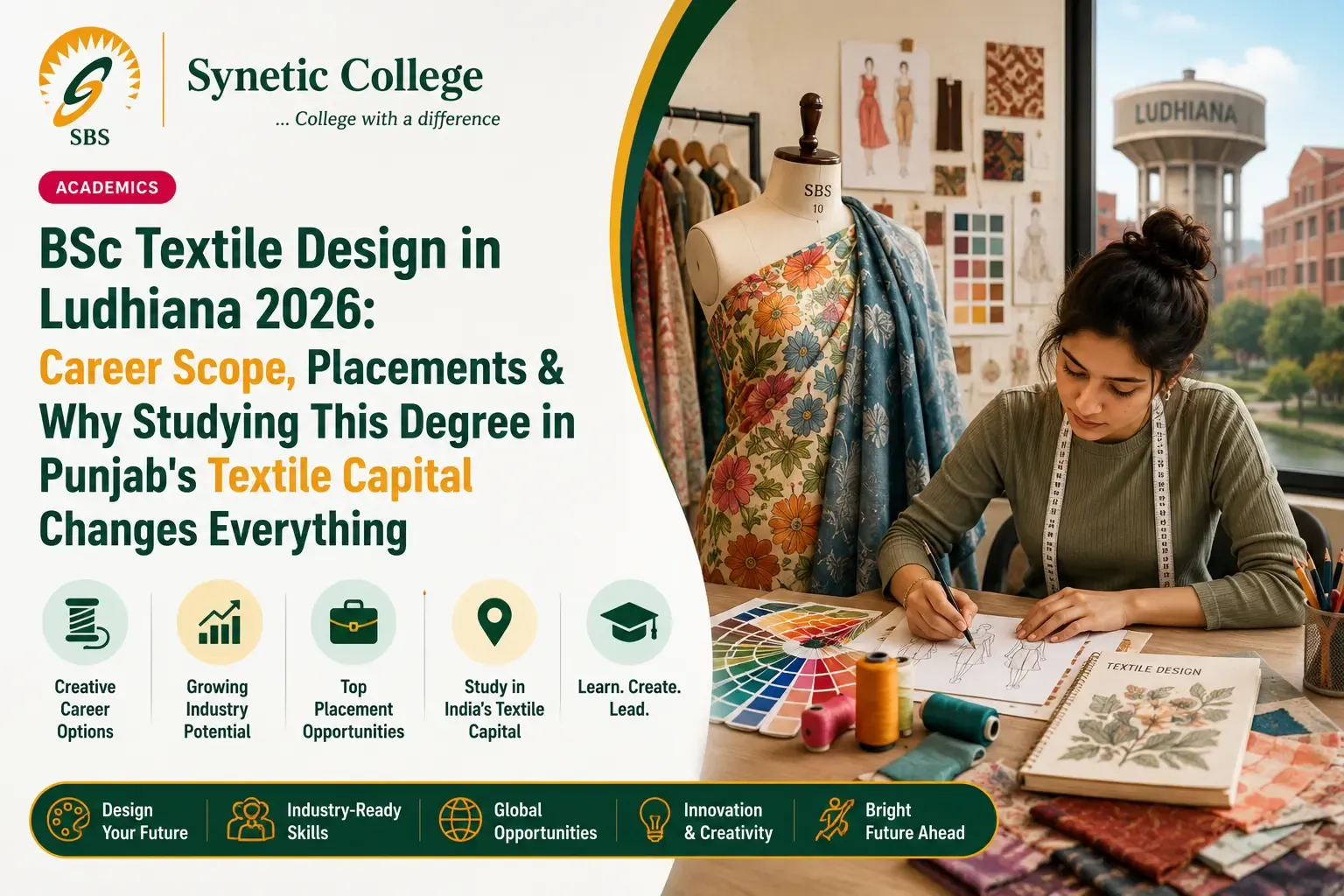
India's textile industry is a ₹152 billion economy. Ludhiana produces 95% of India's knitwear. And SBS's BSc Textile Design degree is 70% practical, industry-trained, and placed into real companies every year. Here is everything you need to know.
The Degree That Puts You at the Centre of India's ₹152 Billion Textile Economy
India's textile market reached USD 152.40 billion in 2025 and is projected to reach USD 213.75 billion by 2034. The industry supports over 45 million jobs and contributes approximately 2.3% of India's GDP. India is the third largest exporter of textiles and apparel in the world, with exports targeted at USD 100 billion.
Behind every garment, every fabric collection, every export order, and every retail shelf display is a textile designer — the professional who bridges creative vision and industrial production.
And the single best city in India to study textile design? The city producing 95% of India's knitwear. The city with over 10,000 textile industrial units. The city the BBC calls "India's Manchester."
Ludhiana. And Synetic Business School.
Textile Design vs. Fashion Design: The Distinction Nobody Explains Clearly
If you are researching design courses after 12th, you have almost certainly encountered both "Textile Design" and "Fashion Design" as options — and you may be confused about what actually separates them. This distinction matters enormously for your career.
What Fashion Design Actually Is
Fashion design is primarily about garment creation and styling — the aesthetics of clothing as a finished product. A fashion designer conceptualises silhouettes, shapes, cuts, and collections. The work is creative and trend-driven. Fashion designers work in fashion houses, boutiques, design studios, film and entertainment, and high-end retail.
Fashion design is an exciting field. But it is also intensely competitive, concentrated in metro cities (Mumbai and Delhi dominate India's fashion industry), and highly dependent on portfolio strength, networking, and personal brand. Starting salaries are typically ₹2.5–4.5 LPA, with significant income coming only to those who establish strong industry networks or their own label.
Fashion design is a creative art career that requires extraordinary persistence and metropolitan connections to reach its ceiling.
What Textile Design Actually Is
Textile design is the discipline behind the fabric itself — the patterns, weaves, prints, textures, constructions, and material innovations that go into the cloth before any garment is cut. A textile designer works at the intersection of creativity, technology, and industrial production.
Textile designers work in:
- Textile mills and fabric manufacturing companies creating seasonal collections
- Garment and hosiery export houses developing designs for international buyers
- Home furnishing and décor companies designing upholstery, curtains, and bedlinen
- Sportswear and performance apparel brands developing technical fabrics
- Fashion brands as the upstream suppliers of the fabrics their fashion designers use
- Smart textile and wearable technology companies (the fastest-growing frontier)
The critical difference: A fashion designer creates the garment. A textile designer creates the fabric the garment is made from. Both are essential. But textile design feeds into an industrial production pipeline that is far larger, far more geographically distributed, and far more consistently hiring than the fashion design pipeline.
Which Has Better Career Scope in India in 2026?
The honest answer for most students — particularly in Punjab — is textile design offers more consistent, geographically accessible employment with strong salary growth. Fashion design offers higher creative prestige but demands metropolitan proximity and intensive networking that can take years to yield returns.
Textile design graduates in Ludhiana can walk into job interviews at companies within a 10-kilometre radius of SBS campus. Fashion design graduates in Ludhiana typically need to relocate to Mumbai or Delhi to access their primary job market.
This is not a criticism of fashion design. It is geography and industry reality, honestly stated.
The SBS BSc Textile Design Degree: What Makes It Different
70% Practical. 30% Theory.
This ratio is the defining characteristic of the SBS B.Sc Textile Design program, and it is the single biggest differentiator from most textile design courses in India.
Most design degrees follow an 80:20 or 70:30 split — heavy on theory, light on hands-on production. Students spend years learning about fabric construction, pattern theory, and textile history without ever operating a loom, working with a sampling team, or understanding a production line.
At SBS, the structure is reversed in practice: 70% of learning happens through doing.
By the time an SBS Textile Design graduate walks into a job interview, they have already:
- Worked extensively with fabric samples, swatches, and pattern construction
- Developed print designs, woven patterns, and surface texture collections
- Used industry-standard design software including Adobe Illustrator, Photoshop, and CAD design tools
- Visited Ludhiana's actual textile manufacturers and export houses
- Understood the full cycle from fibre to finished fabric to retail product
- Built a portfolio of real design work — not just academic exercises
That portfolio is not theoretical. It is tangible, reviewable work that demonstrates genuine skill to employers.
Industry Training Built Into the Curriculum
SBS's location in Ludhiana — India's textile capital — means industry training is structurally accessible in a way it simply cannot be at colleges in cities without this industrial density.
Our Textile Design students have visited and trained with:
- Jawandsons Pvt. Ltd. — one of Ludhiana's leading textile manufacturing and export houses, offering direct exposure to fabric production, buyer specifications, and export-quality standards
- Neva Garments Ltd. — witnessing the garment manufacturing process from fabric to finished product to retail
- GMMSA Expo — Ludhiana's premier textile machinery and innovation exhibition, where students see the latest advancements in knitting, weaving, and digital textile production
- PAU's Swadeshi Mela — where SBS Textile Design students performed a celebrated fashion show representing India's diverse cultural textile heritage, earning a standing ovation
These are not optional excursions. They are integrated into the curriculum — structured visits with faculty guidance, pre-visit briefings, and post-visit reflection.
The PAU Fashion Show: What Practical Confidence Looks Like
In March 2026, SBS Textile Design students represented the diverse cultural heritage of Indian states through a vibrant fashion show at Punjab Agricultural University's Swadeshi Mela — one of Ludhiana's most prestigious annual gatherings. The performance drew a standing ovation.
This was not just a performance. It was a demonstration of what practical textile education produces: students confident enough to stand on a public stage, dress 12 different states of India authentically, and communicate cultural identity through the language of fabric and design.
That is the SBS Textile Design student.
Career Roles and Salaries: What BSc Textile Design Graduates Actually Do
Core Career Paths in Textile Design
Textile Designer (Fabric Collections)
Developing seasonal print, pattern, and weave collections for garment brands, export houses, and fabric manufacturers. This is the primary role for most B.Sc Textile Design graduates entering the Ludhiana market.
- Fresher salary: ₹3–5 LPA
- 3–5 years experience: ₹6–10 LPA
Graphic Designer for Textile / Print Studio
Using Photoshop, Illustrator, and digital printing software to create repeat patterns, surface textures, and digital prints for fabric production. Increasingly in demand as digital textile printing replaces traditional screen printing.
- Fresher salary: ₹2.5–5 LPA
- With portfolio and software skills: ₹5–10 LPA
Fashion Merchandiser / Buyer's Assistant
Working at the commercial interface between designers and retailers — managing product ranges, inventory planning, and buyer specifications for garment brands and export companies.
- Fresher salary: ₹3–4.5 LPA
Garment Technologist / Quality Controller
Ensuring that garments produced in factories meet buyer quality specifications — fabric testing, construction standards, size grading, and export compliance. Export houses and manufacturing companies hire actively in this role.
- Fresher salary: ₹3–5 LPA
Product Developer (Apparel and Home Textiles)
Developing new products in collaboration with design and production teams — sampling, sourcing fabrics, and bringing new collections from concept to production-ready specification.
- Fresher salary: ₹3–5 LPA
Independent Designer / Entrepreneur
Ludhiana's textile infrastructure makes it one of the best cities in India to start a design-led textile or apparel business. Access to fabric manufacturers, export knowledge, and production expertise is closer here than anywhere else in North India. Experienced textile designers who start their own labels or consultancies can earn ₹12–30 LPA or beyond.
Salary Summary: BSc Textile Design
- Fresher (0–2 years): ₹3–5.5 LPA
- Mid-career (3–5 years): ₹6–10 LPA
- Senior designer / art director: ₹10–20 LPA+
- Independent label / freelance consultant: Income uncapped with strong portfolio
Starting salaries for B.Sc Textile Design in Ludhiana are competitive with similar degrees in other disciplines — and the Ludhiana location advantage means graduates access employment faster, with better industry knowledge, than graduates from cities without this industrial base.
The Fashion Designing Diploma: SBS's Faster Pathway Into Design Careers
For students who want to enter the design industry sooner, SBS also offers a Diploma in Fashion Designing through SIMTA — ISO 9001:2015 certified and structured with the same practical philosophy as the degree program.
What the Fashion Designing Diploma Covers
The diploma covers garment construction, pattern making, fashion illustration, fabric studies, colour theory, and introductory design software — building the foundational skills for entry-level design and production roles.
Duration: 1 year (Basic Diploma) to 2 years (Advanced Diploma)
Who it is for:
- Students who want a faster entry into the fashion and design industry
- Students who want to test their aptitude for design before committing to a 3-year degree
- Students who have already completed other education and want to add design skills
- Students from any stream — Science, Commerce, or Arts
Career entry points after the Fashion Designing Diploma:
- Junior designer at boutiques, fashion studios, or garment export houses
- Fashion assistant at retail brands
- Pattern making and garment production roles
- Self-employment in tailoring, alterations, and small-scale design
The upgrade path: Many diploma graduates pursue the B.Sc Textile Design degree subsequently, using their diploma experience as a foundation that makes the degree significantly more productive. At SBS, your educational journey can be designed — not just assigned.
Why Ludhiana-Based Placements Are Genuinely Exceptional for Textile Students
This is the point that most colleges cannot make about their textile programs — because they are not located in Ludhiana.
When an SBS Textile Design student completes their degree, they are not looking for a job in an industry they have only read about. They have:
- Visited the companies that will interview them
- Understood the production processes those companies use
- Developed designs in the aesthetic language those companies work in
- Built relationships with faculty who have industry connections in those very companies
Ludhiana's textile industry has over 10,000 industrial units. The city has companies across every segment of the textile value chain — spinning, weaving, knitting, dyeing, finishing, garment manufacturing, export, and retail. The placement opportunity for a trained textile design graduate in Ludhiana is structurally unmatched anywhere in Punjab.
SBS's UMEED Mega Job Fair — attended by 35+ companies including textile and garment companies, retail brands, and manufacturing firms — is another placement channel that complements the direct industry access Ludhiana provides.
Our B.Sc Textile Design graduates have the highest placement rates among SBS programs — because the demand in our own city for what they know is continuous, not seasonal.
Is BSc Textile Design Right for You?
This program is designed for students who fit this profile:
- You are creative and have a strong sense of colour, pattern, and visual composition
- You are interested in fabric, material, and the tactile properties of design — not just the finished garment
- You want a career with consistent industrial employment, not just in fashion houses
- You want to work in Ludhiana, Punjab, and Northern India — or eventually in international textile markets
- You are from any stream — Science, Commerce, or Arts. The program is open to all
- You want to learn by doing, not just by reading and listening
- You want to be placed in your first job, not just educated for it
Frequently Asked Questions
What is the difference between BSc Textile Design and Fashion Design?
BSc Textile Design focuses on the fabric itself — patterns, weaves, prints, surface design, and the material science of textiles. Fashion Design focuses on garment creation, silhouette, and styling. Both are valuable, but Textile Design feeds into industrial manufacturing pipelines that are far larger and more consistently hiring in Punjab. Fashion Design is more concentrated in metro fashion markets.
What is the career scope of BSc Textile Design in India in 2026?
Strong and growing. India's textile market is projected to reach USD 213.75 billion by 2034. Ludhiana alone produces 95% of India's knitwear, with over 10,000 industrial units requiring textile design professionals. Career roles include Textile Designer, Graphic/Print Designer, Fashion Merchandiser, Garment Technologist, Product Developer, and independent designer/entrepreneur.
What is the salary after BSc Textile Design in India?
Freshers earn ₹3–5.5 LPA. Mid-career professionals with 3–5 years experience earn ₹6–10 LPA. Senior designers and art directors earn ₹10–20 LPA+. Independent designers and consultants have uncapped earning potential. Textile designers with digital printing, CAD, and sustainability expertise command a premium.
Is BSc Textile Design practical or mostly theory at SBS?
At SBS, the program is 70% practical and 30% theoretical. Students work with fabrics, develop print and pattern collections, use industry-standard software, complete structured industrial visits to Ludhiana's textile companies, and graduate with a real design portfolio — not just academic certificates.
Can Commerce or Arts students do BSc Textile Design?
Yes. SBS's B.Sc Textile Design program is open to students from all streams — Science, Commerce, and Arts. Creative aptitude, an interest in design and fabric, and a willingness to work practically are far more important than academic stream.
What companies hire BSc Textile Design graduates in Ludhiana?
Ludhiana's 10,000+ textile industrial units are the primary employment base — including Vardhman Textiles, Shingora Textiles, Jawandsons, Neva Garments, and hundreds of export houses and garment manufacturers. Retail brands, home furnishing companies, and fashion labels also hire textile design graduates. Nationally, Raymond, Fabindia, and garment export houses across India actively recruit.
What is the Fashion Designing Diploma at SBS?
SBS's SIMTA-certified Diploma in Fashion Designing is a 1–2 year ISO 9001:2015 certified program covering garment construction, pattern making, fashion illustration, colour theory, and basic design software. It is open to all streams and provides faster entry into design industry roles. Many diploma students subsequently pursue the B.Sc Textile Design degree.
How are placements for BSc Textile Design at SBS?
B.Sc Textile Design has SBS's highest placement rate among programs. Ludhiana's position as India's textile capital means employers are geographically proximate — SBS Textile Design graduates enter a job market where local demand is consistent and continuous. The annual UMEED Mega Job Fair (35+ companies) and direct industry relationships further support placement outcomes.
Is Ludhiana a good place to study Textile Design specifically?
Yes — it is arguably the best. Ludhiana produces 95% of India's knitwear, has over 10,000 textile industrial units, and is the hub of North India's garment and hosiery industry. Studying textile design here means your industrial visits, internships, and first job opportunities are within the same city or a short drive away. No other city in Punjab — or North India — offers this structural advantage for textile education.
What is the intake for BSc Textile Design at SBS and when do admissions open?
Admissions for the 2026–27 academic year are currently open. Seats are limited. Visit SBS campus on Chandigarh Road, Ludhiana (near Fortis Hospital), apply online, or WhatsApp our admissions team. Our counsellors will walk you through eligibility, program structure, and placement outcomes.
Explore at SBS
Written by
Faculty, SBS
Synetic Business School — sharing stories, insights, and updates from our campus in Ludhiana, Punjab.