
Canada Is Rejecting Up to 80% of Indian Student Visas in 2025 — Why Punjab & Ludhiana Students Are Rethinking the Plan
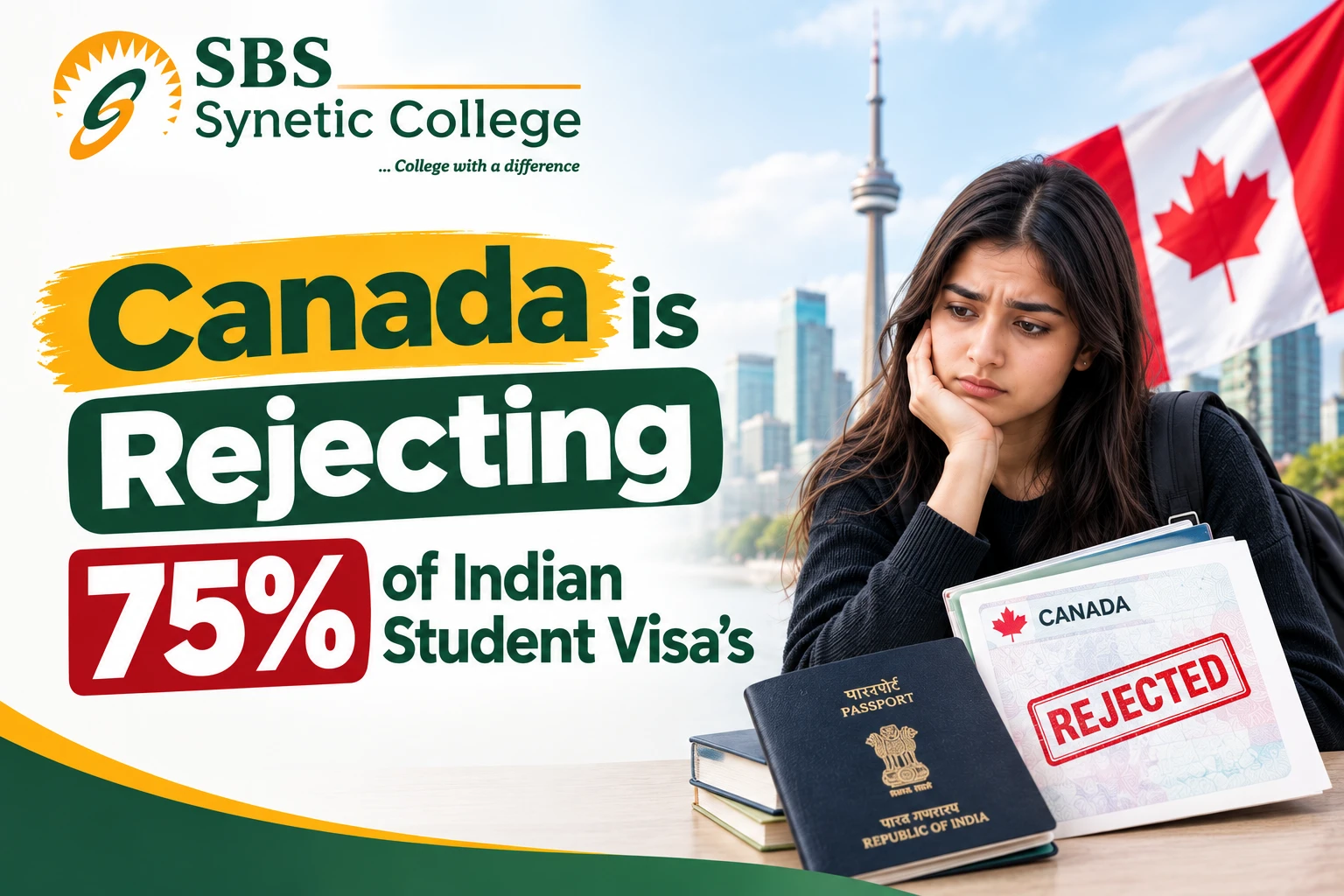
Canada's Indian student visa rejection rate has jumped from 32% to 74–80% in just two years. Here's the year-by-year data, why Punjab is hit hardest, and why an Indian bachelor's degree first — then Canada or the UK — is now the safer, smarter path.
The "Canada First" Plan Isn't the Safe Bet It Used to Be
For over a decade, the default plan for thousands of Punjab and Ludhiana families was almost automatic: finish 12th grade, take an IELTS coaching course, hire a consultant, and fly to Canada for an undergraduate diploma or degree. It's the reason "PR through Canada" became a household phrase across Punjab. That plan hasn't just gotten harder in 2025 — the data shows it's becoming genuinely risky, and the trend has moved in only one direction for three straight years.
Canada rejected 74% of Indian study permit applications in August 2025, up from just 32% in the same month two years earlier — more than double, in the space of 24 months. Careers360's analysis of IRCC data puts Canada's overall study-permit rejection rate at around 40% for the same month — meaning Indian applicants are being refused at nearly double the rate of the average applicant. Other year-round analyses for 2025 put the Indian rejection rate even higher, approaching 80% across the full year. Compare that to Chinese applicants, who faced only a 24% rejection rate in the same period — the gap isn't a coincidence.
Why the Rejections Have Climbed Every Year Since 2023
This isn't one policy change — it's three compounding ones, stacked over 18 months:
1. A fraud crackdown that specifically targets India. Canada's immigration department flagged over 14,000 potentially fraudulent letters of acceptance in a single recent year, and separate reports covering 2024–25 put the number of fake admission letters at close to 10,000 — with roughly 80% of those cases reportedly traced back to applicants and consultants in Punjab and Gujarat. Genuine applicants from these states are now getting caught in visa officers' heightened scrutiny alongside the fraudulent ones.
2. Canada is actively shrinking its international student numbers. IRCC capped 2025 study permits at 437,000 — a 10% cut from 2024's already-reduced target of 485,000. This is a declared policy goal, not an accident: Canada wants fewer temporary residents overall, and international students are the single largest lever it can pull.
3. The easiest approval pathway for Indian students no longer exists. The Student Direct Stream (SDS) — which fast-tracked Indian applications to a decision in about 20 days with meaningfully higher approval odds — was discontinued without warning on November 8, 2024. Every Indian application since has gone through standard processing, which now takes 8–14 weeks, and up to 20 weeks for anything requiring extra documentation.
On top of all this, the single most common reason cited in individual rejection letters in 2024 was a visa officer's doubt that the student would actually leave Canada after their studies — cited in more than 75% of refusals. That's a subjective judgment call, not a checklist a student can fully control.
Punjab Is Absorbing the Worst of This
Punjab — alongside Gujarat and Haryana — has long been Canada's single largest source of Indian students, which means this crackdown isn't landing evenly across India. It's landing hardest exactly where Ludhiana sits.
- Nearly 10,000 fake admission letters were flagged in reports covering 2024–25, with an estimated 80% of cases linked to consultants and applicants from Punjab and Gujarat specifically
- Over 700 Punjab students were caught up in a single fake-offer-letter scam run by one consultant, facing deportation from Canada — serious enough that the Punjab government stepped in to provide free legal aid
- New Indian regulations taking effect July 15, 2026 will make immigration consultants who cheat or mislead clients liable for fines of up to ₹9 crore and jail time — a direct response to how widespread agent fraud has become in exactly this corridor
Families that spend anywhere from ₹15–30 lakh on consultants, IELTS coaching, and a full Canadian tuition deposit are now doing it against a genuine, well-documented chance of outright rejection — sometimes for reasons that have nothing to do with the student's own academic merit.
The Smarter Order: Bachelor's in India First, Canada or the UK After
None of this means Canada or the UK are off the table — it means the order matters more than it used to. Instead of gambling a first-attempt visa application straight out of 12th grade, an increasing number of Punjab and Ludhiana students are completing their undergraduate degree in India first — then applying abroad for a master's degree or a job, as a stronger, lower-risk applicant.
Bachelor's Degree at SBS (India)
3–4 years, UGC-recognised, English-medium instruction — a genuine academic record built without betting everything on a first-attempt Canada visa
Placement or Work Experience
SBS's placement cell connects graduates with real employers, adding demonstrated career intent to a future visa file — not just intentions on paper
Visa-Ready Documentation from SBS
Bonafide Certificate, Letter of Recommendation (LOR), Medium of Instruction (MOI) Certificate, and official transcripts — prepared directly by SBS's Admissions & Academic departments
Apply Abroad as a Graduate, Not a Fresher
Apply to Canada, the UK, or elsewhere with a completed degree, a specific master's program in mind, and a stronger financial and academic profile
This is exactly the route several SBS graduates have already taken — completing their bachelor's degree at SBS in Ludhiana, then going on to pursue further studies or employment in Canada and the UK. A completed Indian degree, real work or placement experience, and a specific, well-documented reason for going abroad is a fundamentally different — and fundamentally stronger — visa profile than a fresh 12th-pass applicant with no track record for an officer to evaluate.
Why a Completed Degree Lowers Your Visa Risk
Visa officers are weighing three things above everything else: genuine intent, financial credibility, and academic seriousness. A student applying straight after 12th grade has none of these established yet — just promises on paper, which is precisely what's driving the current wave of "intent to return" rejections. A graduate applying with a completed UGC-recognised degree, placement or work history, and a specific, funded master's program already has all three demonstrated with evidence, not intentions.
There's a financial logic to this too. A Canadian undergraduate program can run CAD $15,000–25,000 a year in tuition alone, paid upfront against a rejection risk that's now above 70% for Indian applicants. Completing an affordable bachelor's degree in India first — then applying for a shorter master's program abroad as a stronger applicant — puts far less money at risk on a single roll of the dice.
How SBS Supports Students Planning to Go Abroad After Graduation
This is exactly where SBS's Admissions and Academic departments step in directly. Students planning further studies or work abroad after their SBS degree are supported with:
- Bonafide Certificates confirming enrollment and academic standing
- Letters of Recommendation (LOR) from faculty who've actually taught and mentored the student
- Medium of Instruction (MOI) Certificates — a document Canadian and UK universities frequently require in place of an English proficiency test, when the entire degree was taught in English
- Official transcripts and other visa-specific documentation, prepared and verified directly by the college
None of this is something a graduating student has to figure out alone through a paid consultant — it's built into how SBS supports students at the exact point they're ready to apply abroad.
The Bottom Line
Canada isn't disappearing as a destination — but going there first, straight out of 12th grade, is a materially riskier bet in 2025 than it was even two years ago, and Punjab families are absorbing more of that risk than almost anyone else in India. Completing an undergraduate degree in India first — at an institution that actively supports the visa documentation students will eventually need — keeps the Canada or UK dream alive while removing the single biggest gamble from it: betting a full undergraduate education on a visa decision that's now being refused three times out of four.
Frequently Asked Questions
What percentage of Indian student visas is Canada rejecting in 2025?
Canada rejected 74% of Indian study permit applications in August 2025, up from 32% in August 2023. Some full-year 2025 estimates put the Indian rejection rate even higher, approaching 80%, against an overall study-permit rejection rate of around 40% across all nationalities.
Why are so many Indian student visa applications being rejected by Canada right now?
Three compounding factors: a fraud crackdown after thousands of fake admission letters were flagged, a declared government policy to reduce Canada's temporary resident population by capping study permits, and the discontinuation of the Student Direct Stream (SDS) fast-track program in November 2024, which pushed all Indian applications into slower, stricter standard processing.
Why has Punjab been hit particularly hard by Canada's visa crackdown?
Punjab has long been Canada's largest source state for Indian students, and reports covering 2024–25 estimate that around 80% of the fake admission letters flagged in Canada's fraud crackdown were linked to consultants and applicants from Punjab and Gujarat. Genuine Punjab applicants are now facing heightened scrutiny as a direct result.
Is Canada still a realistic option for Indian students at all?
Yes, but the odds are meaningfully worse than they were even two years ago, and a first-time applicant straight out of 12th grade is taking on the most risk. A stronger academic and financial profile — such as a completed bachelor's degree — significantly improves an application's credibility with visa officers.
Does it actually make sense to study in India first and go abroad later?
Yes. A student applying abroad with a completed UGC-recognised degree, real work or placement experience, and a specific higher-study plan presents visa officers with demonstrated intent and financial credibility — exactly what's missing from a fresh 12th-pass application, and exactly what's driving the current wave of rejections.
Does SBS help students who plan to study or work in Canada or the UK after their degree?
Yes. Several SBS graduates have gone on to pursue further studies or jobs in Canada and the UK after completing their bachelor's degree at SBS, and the Admissions and Academic departments directly support this with Bonafide Certificates, Letters of Recommendation, Medium of Instruction Certificates, and other visa-required documentation.
What is a Medium of Instruction (MOI) Certificate, and why does it matter for a Canada or UK visa?
It's an official document confirming a student's entire degree was taught in English. Canadian and UK universities often accept it in place of a separate English-language test score, provided the applicant's college issues it — which is one of the documents SBS's Academic department prepares directly for graduating students.
What happened to Canada's Student Direct Stream (SDS) for Indian applicants?
It was discontinued without prior warning on November 8, 2024. SDS previously fast-tracked Indian study permit decisions in about 20 days with better approval odds; every Indian application since has gone through standard processing, which now takes 8–14 weeks, and up to 20 weeks for applications needing extra documentation.
The safest way to still reach Canada or the UK in 2026 isn't skipping India — it's starting here. — SBS Admissions Office
Written by
SBS Admissions Office
Synetic Business School — sharing stories, insights, and updates from our campus in Ludhiana, Punjab.